


76mm Low Noise Frameless BLDC Motor for Robotics
 Aug 31, 2026|
 View:472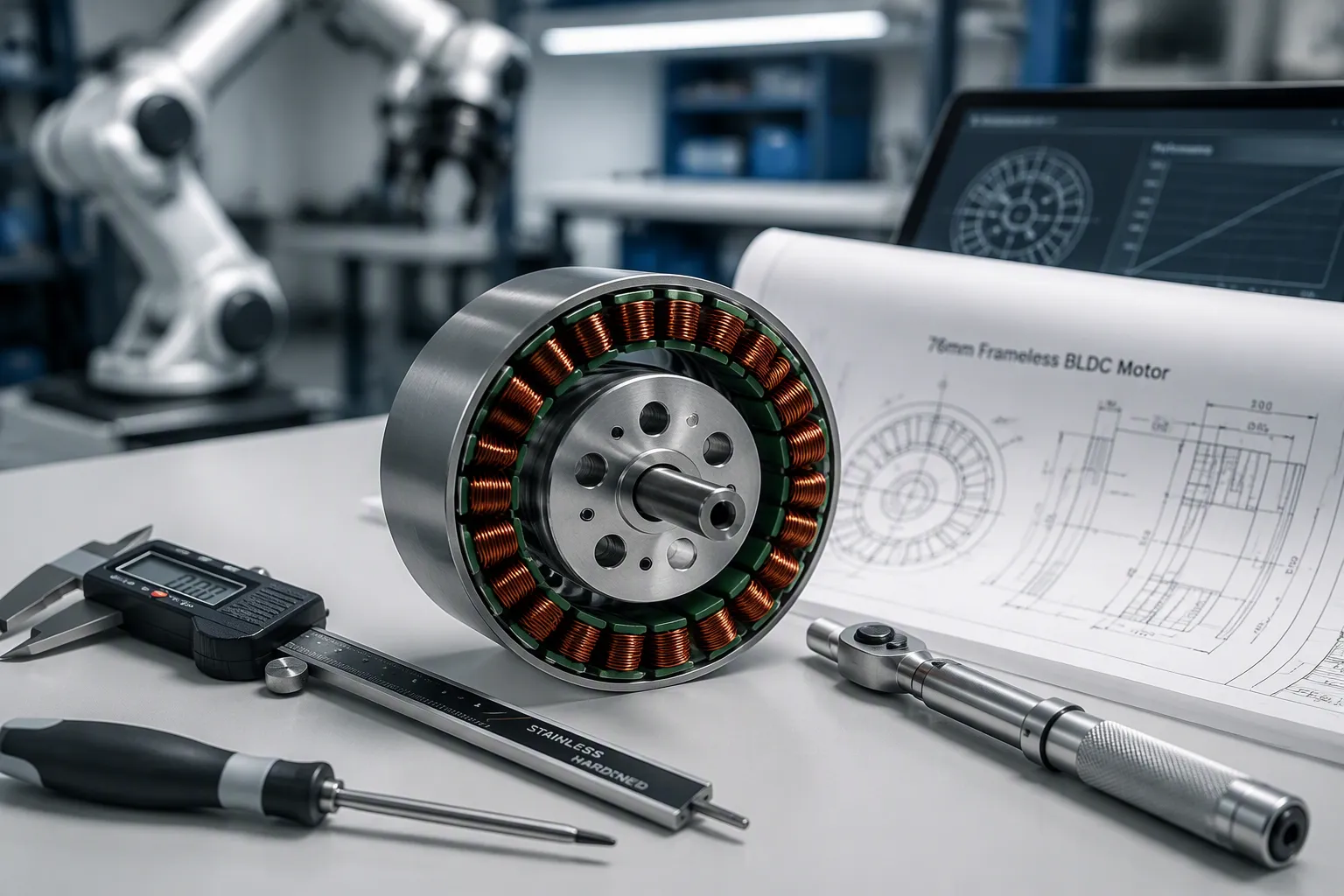
Robotics engineers face a growing problem: they need motors that are quiet, small, and strong. This need is especially strong in collaborative and medical robots, where noise can bother patients or interrupt careful work. How can you get exact motion control without the heavy parts and loud noise of regular motors?
The answer is the 76mm Low Noise Frameless BLDC Motor. Its frameless design removes the outer shell, saving useful space and cutting weight. Smart engineering keeps sound levels below 50dB, making it perfect for sensitive places. Sunrise Electric Motor, a trusted industry leader, builds this motor with care and dependability. This post looks at its design benefits, noise-reduction technology, specs, and real-world uses.
Key Takeaways
Frameless motors save space and weight because they have no outer shell. This lets them fit directly into robot joints for better performance.
Modern noise-reduction techniques keep these motors' noise below 50 decibels, making them ideal for quiet places like hospitals and offices.
This motor works with voltages from 48 to 325VDC and torque up to 3.3Nm, so it suits many robotic applications.
Direct drive removes backlash and cuts maintenance, giving quicker response and better precision.
You can customize the shaft, mounting, and feedback sensors to make sure they fit your robot design perfectly.
Frameless BLDC Motor Design Advantages
The frameless design removes the motor's outer shell. You get only the stator and rotor parts. Your robot's joint becomes the motor's frame. This idea changes how you put everything together.
Space and Weight Savings for Compact Robots
Old motors have heavy aluminum cases and mounting parts. A frameless BLDC Motor gets rid of those parts. You save a lot of weight in each robot axis. This weight cut helps the robot move faster and better. Lighter arms need less torque to speed up. Smaller motors can then do the same job.
The 76mm size is a good fit for robot joints. This size balances power with size. You get enough torque for hard tasks without extra bulk. The motor fits neatly inside a joint housing. Your robot stays slim and sleek. This small size matters in shared workspaces. Workers feel safer near smaller, less scary machines.
Saving space goes beyond the motor itself. No housing means you don't need extra room for mounting. The stator goes right into your structure. The rotor mounts directly on your load shaft. This setup saves several centimeters per axis. Six-axis arms get a big boost from these combined savings.
Sunrise Electric Motor lets you customize voltage, shaft, and mounting. You can pick the exact setup your design needs. This flexibility helps the motor fit cleanly into your current build.
Direct Integration for Enhanced Performance
The frameless design removes extra parts between the motor and load. No gearboxes. No belts. No couplings. Your load connects straight to the rotor. This direct drive removes several failure points from your system.
Frameless torque motors have no wearing mechanical parts. They can last forever if designed and used correctly. This is very useful for machines that run all the time, where stopping costs a lot of money.
The benefits of removing mechanical parts are clear:
Removing flexible parts like gearboxes, couplings, and belts gets rid of backlash and looseness.
Less looseness gives the system more control, leading to faster moves and stops.
Fewer mechanical links make the system more reliable and improve how it responds to commands.
Backlash disappears in a direct drive system. Every command turns into motion right away. Your robot responds with precision that geared systems can't match. This precision is key for tasks like assembly or surgery help.
The high torque-to-inertia ratio of this frameless BLDC Motor lets it speed up quickly. Your robot can start, stop, and reverse fast. This quick response helps with tasks like pick-and-place. The motor gives smooth, steady torque across its whole speed range.
Fewer parts also mean less upkeep. No gears to oil. No belts to tighten. No couplings to align. Your maintenance team spends less time on checks. Your robot spends more time working.
The direct drive also helps with heat. Heat moves from the stator straight to your structure. This natural path keeps the motor cooler. Cooler operation makes the insulation last longer and keeps torque steady.
Sunrise Electric Motor pairs this motor with compatible drivers. You get a complete motion solution. The engineering team helps with integration questions. This support reduces your risk and speeds up your time to market.
Low Noise Technology Explained
Quiet operation does not happen by accident. Engineers at Sunrise Electric Motor make specific design choices to keep sound below 50dB. This level suits hospitals, offices, and other sensitive spaces. The 76mm Frameless BLDC Motor uses several techniques to achieve this quiet performance.
Acoustic Engineering for Quiet Operation
The stator slot and pole combination plays a big role in noise control. Engineers optimize this pairing to reduce magnetic vibration. A poor combination creates uneven magnetic pull. That pull makes the motor hum or whine during operation. The optimized design smooths out these forces.
Skewed magnets offer another powerful noise-reduction tool. This technique angles the rotor magnets along the shaft. The angle prevents all magnets from aligning with stator teeth at the same time. Instead, the alignment happens gradually. This gradual interaction reduces torque ripple and cogging torque.
Several skewing methods exist:
Rotor skewing angles the magnets themselves
Stator skewing tilts the stator slots instead
Segmented skewing breaks the magnet into smaller pieces at different angles
Each method smooths the magnetic interaction. The result is lower fluctuation and less noise. The skew angle needs careful selection. Too much skew reduces torque output. Too little fails to quiet the motor. Sunrise engineers calculate the optimal angle for each application.
Precision bearings also contribute to quiet running. High-quality bearings spin with less friction and vibration. Standard bearings may have tiny imperfections. These imperfections create audible noise at high speeds. Precision-grade bearings minimize this problem.
Vibration Damping and Precision Balancing
Traditional cased motors transmit more vibration to your robot structure. The housing acts as a sounding board. It amplifies small vibrations into audible noise. A frameless design avoids this problem entirely.
Attribute | Cased Motor | |
|---|---|---|
Transmission components | Fewer (rotor directly connected to shaft) | More (includes coupling, multiple bearing stages) |
System stiffness | Higher (direct connection reduces compliance) | Lower (couplings add flexibility) |
Cogging torque | Reduced via optimized magnetic circuit | Not specifically addressed |
Vibration | Lower (smoother low-speed operation) | Higher (due to backlash and lower stiffness) |
Size/Weight | Smaller and lighter | Larger and heavier |
The direct connection between rotor and load shaft removes compliance. Your robot joint becomes stiffer. Stiffer systems resist vibration better. They also respond faster to control commands.
The robot joint does not require cogging torque, so you must choose a frameless torque motor with low cogging. This will reduce vibration and increase efficiency.
Precision balancing of the rotor assembly further reduces vibration. An unbalanced rotor wobbles slightly during rotation. This wobble creates forces that shake the whole structure. Sunrise balances each rotor to tight tolerances. The result is smooth rotation even at high speeds.
The combination of these techniques delivers a motor that operates below 50dB. You can place it near patients or office workers without disturbance. Your robot performs its tasks quietly and efficiently.
Frameless BLDC Motor Specifications
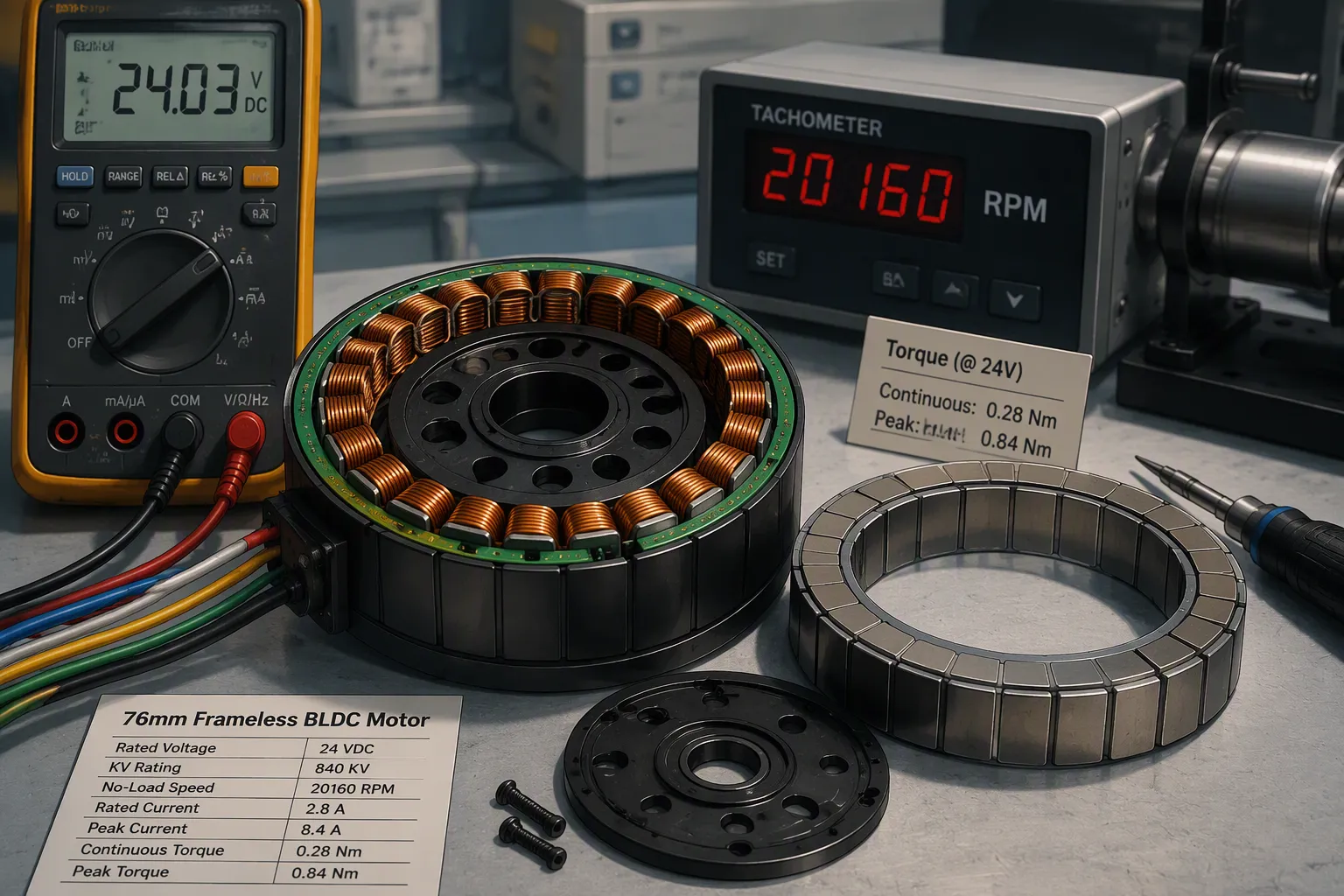
Looking at the numbers behind this motor helps you see if it works for your robot design. The 76mm Low Noise Frameless BLDC Motor gives strong performance in a small size. Its specs cover many robotic uses.
Power, Torque, and Speed Ratings
The motor works with many voltage options. You can run it from 48VDC up to 325VDC. This lets you match the motor to your power system. Lower voltages work for battery robots. Higher voltages suit factory machines with wall power.
Rated torque goes from 0.7Nm to 3.3Nm. This covers many robot joint jobs. Small robot arms need less torque for light tasks. Bigger joints need more torque to lift heavy items. You can pick the torque level your job needs.
Speed ratings go from 1500 to 3000rpm. This speed range helps with fast pick-and-place work. It also handles slow, careful moves like screw driving. The motor keeps smooth torque across this whole speed range.
Specification | Range |
|---|---|
Voltage | 48-325VDC |
Rated Torque | 0.7-3.3Nm |
Rated Speed | 1500-3000rpm |
The high torque-to-inertia ratio matters a lot. This ratio shows how fast the motor can change speed. A high ratio means faster speed-up and slow-down. Your robot reacts to commands almost right away. This fast response is key for active jobs. Assembly robots must start and stop quickly. Sorting systems need fast direction changes. The motor's light rotor makes these moves possible.
Compare this to a geared motor. Gears add weight to the system. That extra weight slows response. Your robot feels slow and less exact. The frameless design avoids this issue. The rotor connects straight to your load with little extra mass.
Electrical Features and Control
The motor uses brushless DC technology. This design removes brushes that wear out. You get longer life and less upkeep. The electronic switching also cuts electrical noise. That cleaner operation helps nearby sensors.
You need a matching driver to run this motor. Sunrise Electric Motor offers drivers that work well together. The driver handles switching and speed control. You can also add an encoder for position data. This setup gives you exact closed-loop control.
The motor's electrical design supports smooth torque output. Improved stator windings reduce cogging. Cogging causes jerky motion at low speeds. The smooth output helps your robot move gently and steadily. This matters for medical devices that touch patients.
Sunrise Electric Motor builds this Frameless BLDC Motor to world standards. The motor has RoHS, TUV, CE, CQC, and IEC approvals. These approvals confirm safety and green compliance. You can use this motor in products sold worldwide. The approvals also make your approval process easier.
The motor's efficiency cuts heat buildup. Less heat means smaller cooling needs. Your robot design stays simpler and more compact. The direct drive setup also boosts electrical efficiency. No gears or belts waste energy through friction.
For control hookup, you can pick from several feedback options. Hall sensors give basic switching data. Encoders offer finer position details. Resolvers work well in tough conditions. Sunrise engineers can help you choose the right feedback for your job.
The electrical time constant affects how fast the motor reacts to voltage changes. A shorter time constant means faster current buildup. This leads to quicker torque response. The motor's design improves this feature for robot uses.
You can ask for custom electrical setups. Sunrise Electric Motor changes winding patterns for different voltage and speed mixes. This customization ensures top performance for your specific robot design.
Robotics Applications and Integration Tips
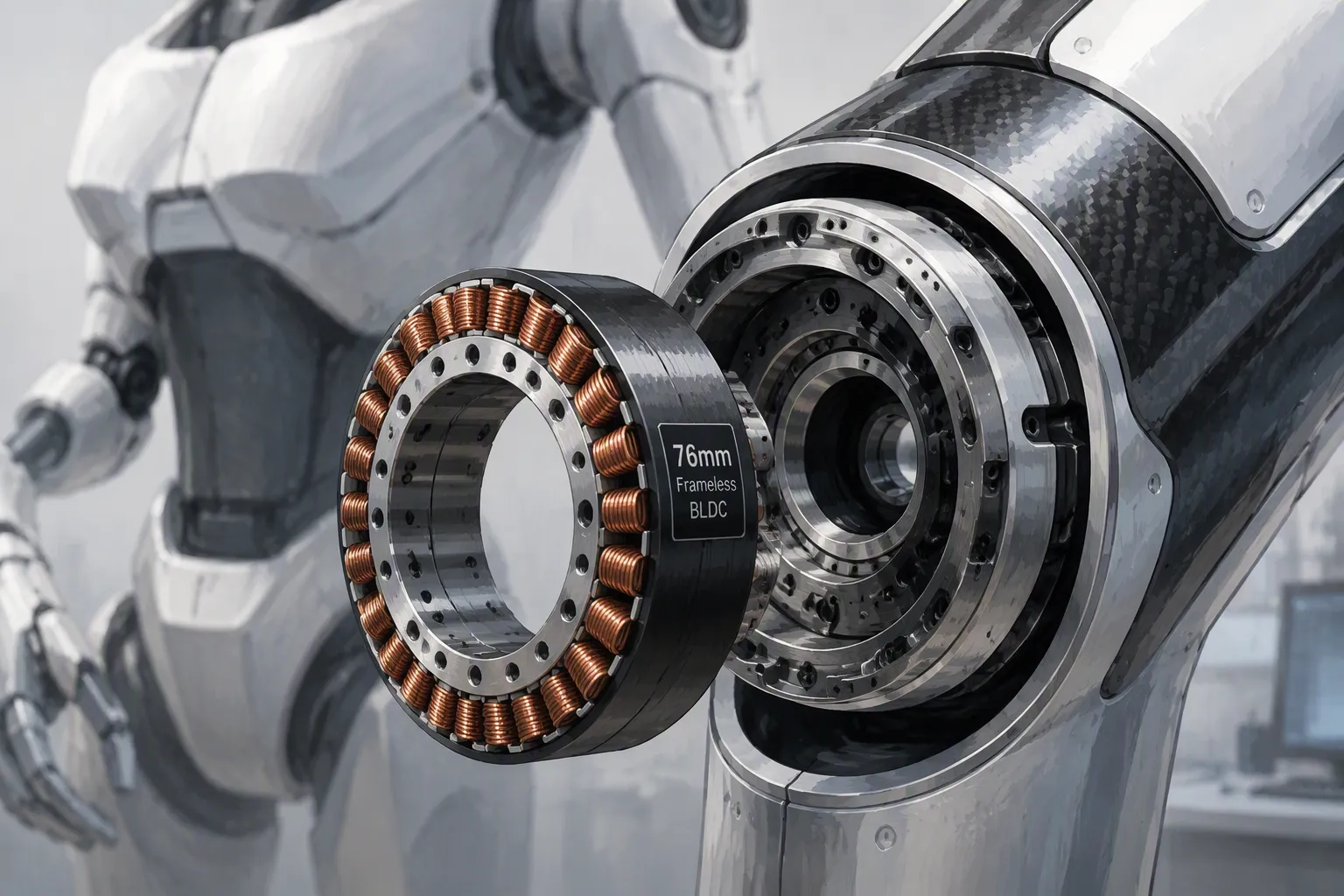
The 76mm Low Noise Frameless BLDC Motor fits many precision machines. You will find it in humanoid robot joints, quadruped robot dogs, and dexterous robotic hands. Medical automation systems use it for surgical robots. Optical precision turntables and aerospace actuation units also benefit from its design. Semiconductor precision handling equipment relies on this motor for exact wafer movement. These industries demand accuracy and quiet operation. The frameless design delivers both without compromise.
Ideal Use Cases in Collaborative and Medical Robotics
Collaborative robots work beside people. They must move gently and stay quiet. The low-noise design keeps sound below 50dB. This makes the motor suitable for offices and labs. Workers can focus without constant whirring in the background. The direct drive benefit removes backlash completely. Your robot responds instantly to commands. This precision matters for assembly tasks and quality checks.
Medical diagnostic equipment presents unique challenges. MRI-compatible systems need special care. The motor's quiet operation reduces patient stress during scans. Patients feel calmer when machinery stays silent. Low vibration maintains image clarity throughout long procedures. This improves diagnostic accuracy and patient comfort simultaneously.
Benefit | Specific Impact on MRI-Compatible Systems |
|---|---|
Quiet operation | Reduces patient stress and contributes to a more comfortable healthcare experience during scans |
Low vibration | Maintains image clarity and improves patient comfort during long scans |
The motor also features low electromagnetic interference. Optimized winding design reduces electromagnetic noise. Shielded enclosures prevent signal interference with sensitive imaging equipment. Sensorless or low-noise commutation methods work well for critical applications. These features protect your diagnostic data from corruption.
Practical Steps for Mounting and Wiring
Start with the custom shaft design. Sunrise Electric Motor offers shaft modifications to match your load interface. You can specify length, diameter, and keyway features. This ensures a secure connection between rotor and driven component.
Encoder selection comes next. Choose Hall sensors for basic speed feedback. Pick an optical encoder for precise position data. Resolvers handle harsh environments with temperature extremes. Your choice depends on the accuracy your application needs.
Driver pairing completes the system. Sunrise provides compatible drivers for seamless integration. The driver handles commutation and speed control automatically. You focus on your robot's higher-level functions instead of motor details.
Mount the stator directly into your robot's structural housing. Use a press fit or light adhesive for secure placement. The rotor slides onto your shaft with a precision fit. Align everything carefully before tightening set screws. Check concentricity to avoid vibration during rotation.
Wire the motor phases to the driver output terminals. Connect feedback wires to the appropriate encoder inputs. Follow the wiring diagram supplied with your driver. Double-check all connections before applying power. Test rotation at low speed first to verify correct phase ordering.
Sunrise Electric Motor's engineering team assists with integration questions. They help you select the right encoder and driver combination. Their support reduces development risk and speeds up your product launch.
The frameless design saves you space and weight in each robot joint. Low-noise technology keeps operation below 50dB for sensitive environments. The specifications fit demanding robotic applications with voltage from 48 to 325VDC and torque from 0.7 to 3.3Nm.
Sunrise Electric Motor offers customization and reliable support. You can adjust shaft, mounting, and voltage to match your design needs. This makes the motor a practical choice for engineers.
Take the next step. Visit the product page for more details. Request a datasheet for full specifications. Contact the engineering team for integration assistance.
FAQ
What makes a frameless motor different from a regular motor?
A frameless motor does not have an outer shell. You get only the stator and rotor. Your robot's body acts as the motor's frame. This saves space and weight. It also means you do not need gearboxes or belts.
How quiet is this motor during operation?
The 76mm frameless BLDC motor runs below 50dB sound pressure level. This works well for hospitals, offices, and other quiet places. The optimized stator design, skewed magnets, and precision bearings all help reduce noise.
What voltage and torque options are available?
You can pick voltages from 48VDC to 325VDC. Rated torque ranges from 0.7Nm to 3.3Nm. Speed options go from 1500 to 3000rpm. This flexibility lets you match the motor to your robot joint needs.
Can I customize the motor for my application?
Yes. Sunrise Electric Motor offers custom shaft design, mounting setup, and voltage needs. You can also choose feedback options like Hall sensors, encoders, or resolvers. The engineering team helps you pick the right mix for your design.
What certifications does this motor hold?
The motor has RoHS, TUV, CE, CQC, and IEC certifications. These approvals show safety and environmental compliance. You can use this motor in products sold in North America, Europe, and other global markets without extra certification steps.


Recommended Products

Frameless DC Motor 170 Series

High Efficiency Frameless Inrunner Torque Motor 115 Series

Customized Low Noise Frameless Motor 76 Series for Robotics & Precision Automation

Customized 24V 36V 48V Frameless BLDC Motor 60 Series

Factory Price Frameless DC Motor 180BL for Robotic Arm

220W 3000rpm High Torque Frameless DC Motor 130BL for Robot Joints

Frameless Brushless DC Motor 90BL

36V Frameless BLDC Motor 80BL With Long Life


Recent News
1.How do Frameless DC Motors differ from brushless motors?
2023-03-302.What are some applications for frameless stepper motors?
2023-04-133.Are Frameless torque motor brushless?
2024-11-074.Advantages and Applications of Frameless Brushless DC Motors
2024-12-065.What is a frameless motor?
2025-02-196.What is a Frameless BLDC Motor?
2025-04-157.What are the components of a frameless motor?
2025-07-108.TOP Frameless Motor manufacturer in china
2025-12-269.Frameless Torque Motors Selection and Applications
2026-07-1410.76mm Low Noise Frameless BLDC Motor for Robotics
2026-08-31


