


How to Select the Right Frameless Motor Series for Your Customer Base: A Wholesaler's Guide to 60, 76, 115, 130 & 180 Series
 Nov 02, 2026|
 View:1
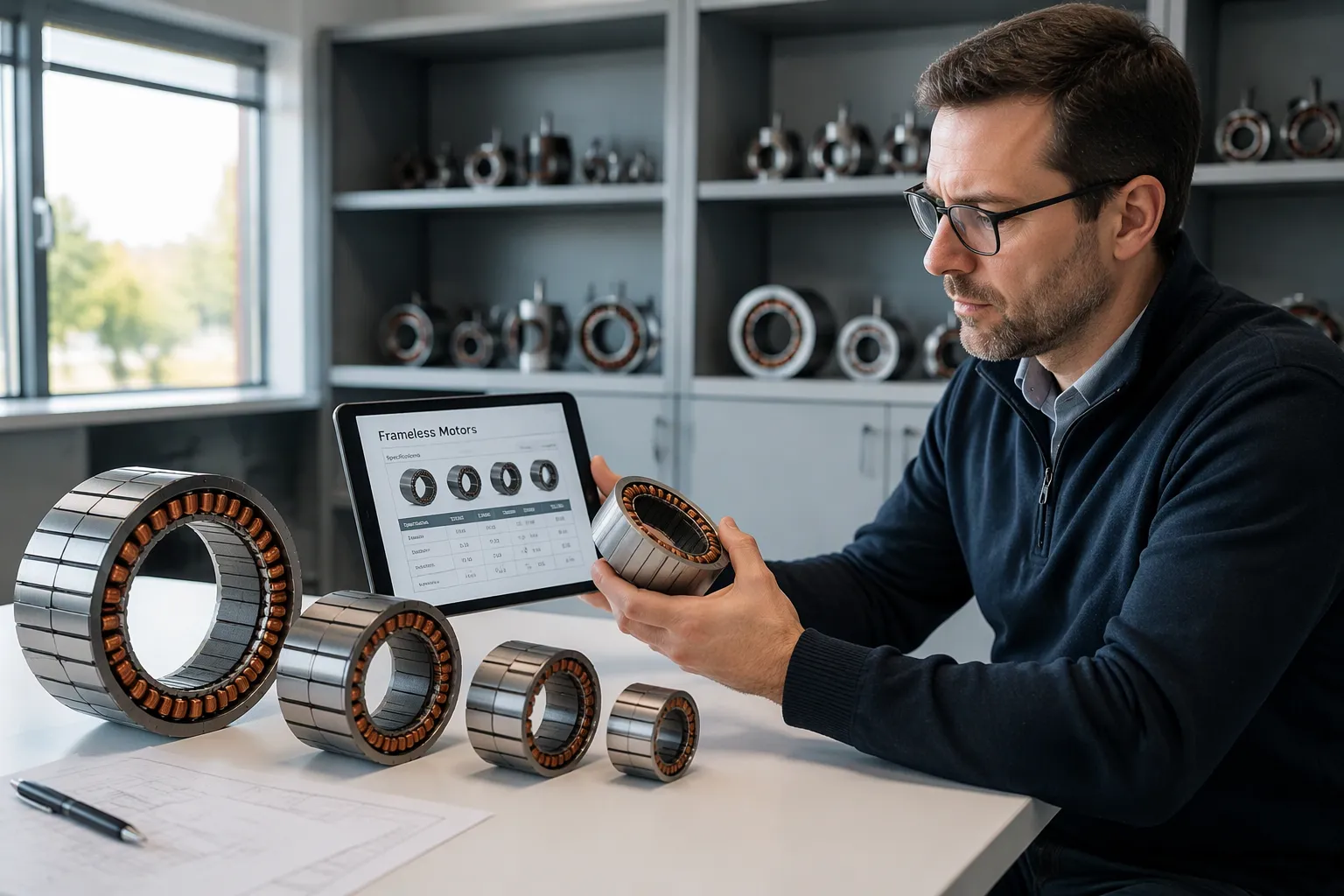
Choosing a series is a business decision. How to select the right frameless motor series protects your profits, reduces returns, and builds customer trust. This guide connects the 60, 76, 115, 130, and 180 series to different customer groups and use cases. You will weigh how well the motor fits the job, plus torque, speed, voltage, size, and deal terms. Each factor really matters in wholesale planning, from price talks to stock choices. Learn how to select the right frameless motor series with confidence. A clear recommendation in the first conversation sets you apart. Customers remember the supplier who matches frameless motors to their machine, not the one who just sends a catalog.
Key Takeaways
Pick the motor series that fits your customer's machine size and torque needs.
Check the torque, speed, and voltage to make sure the motor fits the job.
Make sure the customer's housing can get rid of heat before you suggest a long stack.
Ask suppliers for quotes at different price levels. Then plan your inventory mix by series.
Use a simple four-step checklist every time to pick the right series.
The Five Frameless Motors Series at a Glance
Series Overview and Typical Applications
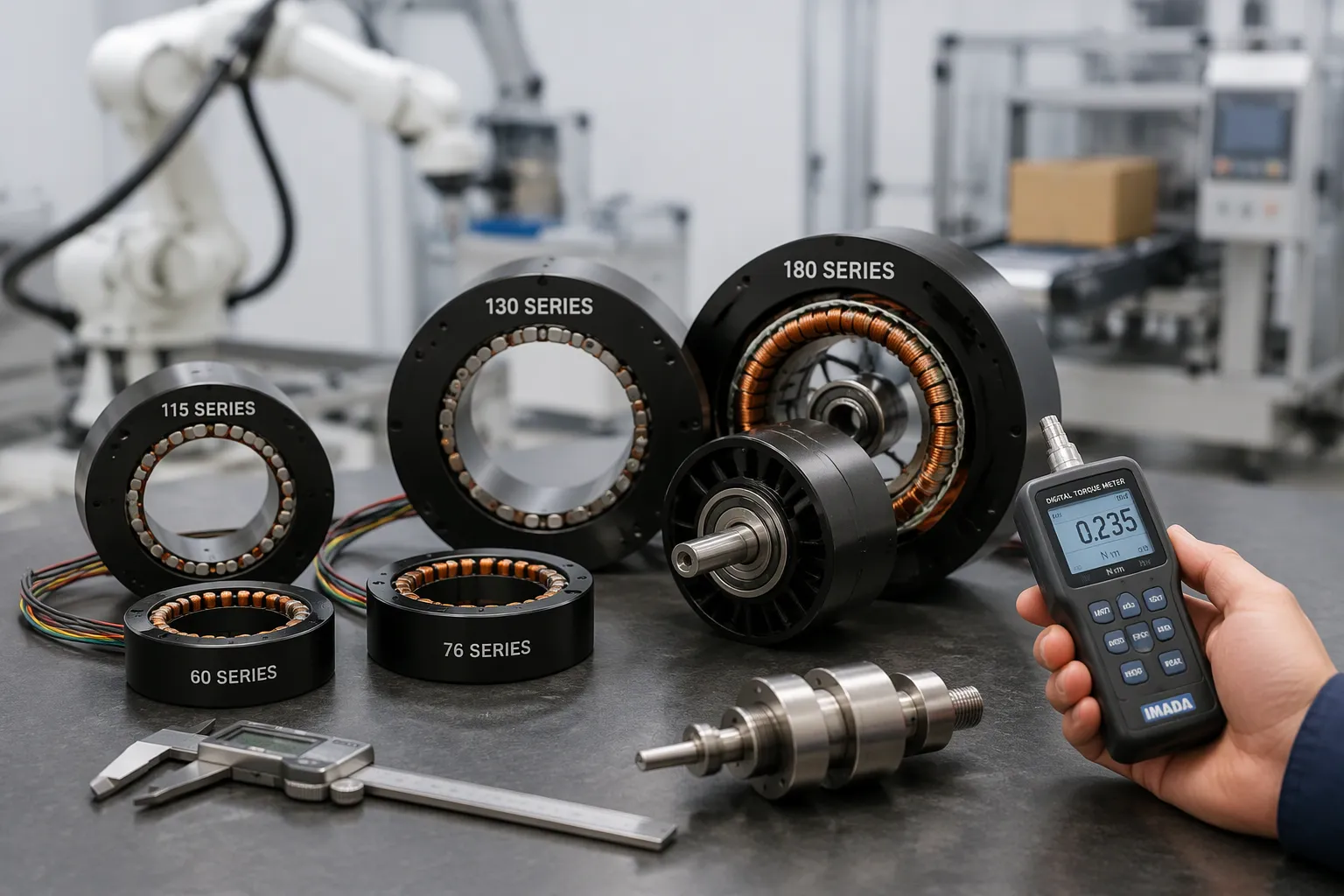
The 60, 76, 115, 130, and 180 series each serve a different group of customers. The 60 series works well for compact spindle and robotic joint designs. The 76 series fits small rotary tables and precision handling equipment. The 115 series is a good choice for mid-size machine tools and packaging lines. The 130 series handles larger envelopes with higher torque demands. The 180 series serves heavy-duty OEM machines. Each series has a job it fits best, and no single size covers every job.
Frameless torque motors accept different magnet and winding configurations. You can match a frameless motor to a customer's unique speed, voltage, and torque requirements. Sunrise Electric Motor brings over 30 years of manufacturing experience to this work. The company offers frameless motors alongside brushed and brushless DC, AC servo, stepper, and customized motor solutions. Its certifications include RoHS, TUV, CE, CQC, and IEC, and it exports to North America and Europe. That track record makes Sunrise a reliable motor supplier for your wholesale business.
How Frame Size Relates to Torque
Frame size sets the torque ceiling for each series. The table below shows the rated figures for four series.
Series | Voltage (Vdc) | Rated Torque (Nm) | Rated Speed (rpm) |
|---|---|---|---|
U60 | 48 | 0.45~1 | 3000 |
U76 | 48 | 0.9~2.1 | 3000 |
U115 | 48 | 3~6.1 | 2000~2500 |
U130 | 48/220 | 5~18 | 400~2000 |
180 | N/A | N/A | N/A |
Larger frame sizes usually deliver more torque. The U60 produces 0.45 to 1 Nm, while the U130 reaches 5 to 18 Nm. Speed moves in the opposite direction. The U60 runs at 3000 rpm, and the U130 spans 400 to 2000 rpm. Higher torque density comes with the larger frames. These frameless servo motors and frameless dc motors give you options across the range. A direct-drive frameless torque motor in the 180 series serves applications beyond the tabled figures. Confirm exact ratings with your supplier before you quote.
How to Select the Right Frameless Motor Series
Torque, Speed, and Voltage Matching
Start with the dominant variable. Ask which single parameter matters most: torque, speed, or physical fit. That one answer narrows the search fast. A machine that needs high torque at low speed points toward a larger frame. A high-speed spindle points toward a smaller one.
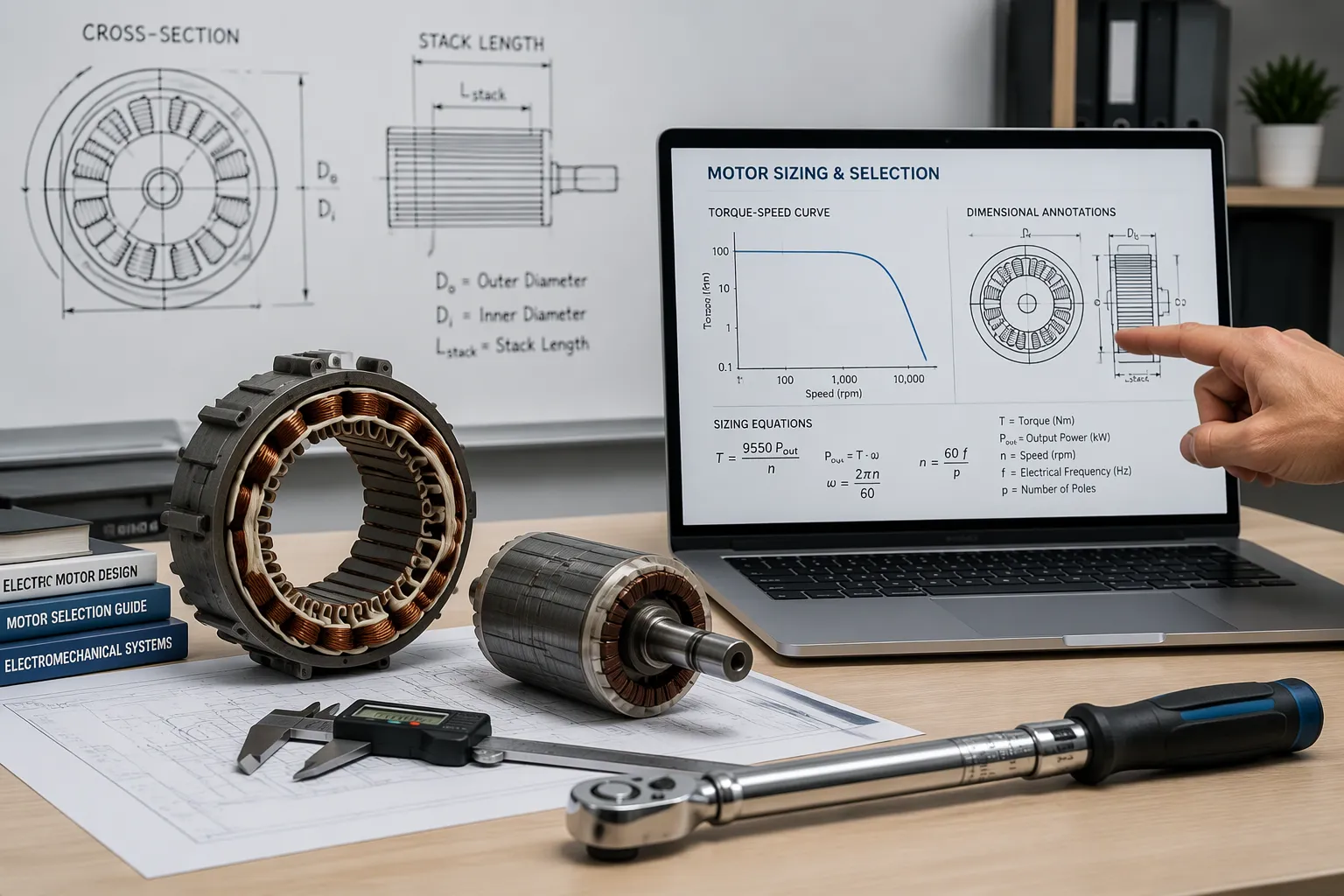
Sizing a frameless motor follows the same logic as a housed motor. You calculate speed and torque from load inertia and acceleration. Acceleration torque equals inertia times angular acceleration, written as T = J × A. Torque is in Nm, inertia in kg·m², and angular acceleration in rad/s². With J = 0.03 kg·m² and A = 20 rad/s², the required acceleration torque is 0.6 Nm. Angular acceleration itself equals the change in angular velocity divided by the time taken, so faster acceleration demands higher torque. Keep the inertia ratio at or below 5:1 for stable motion control.
Voltage and winding choices shape the result. More turns raise the torque constant and lower the usable speed range at a fixed bus voltage. Fewer turns do the opposite. Star and delta connections shift the constants further. Ask your supplier three questions: what torque and speed does this winding deliver at my customer's bus voltage, what current does the drive need, and what margin remains for resistive and inductive drop? These answers turn torque and speed needs into a workable specification.
Dimensions, Stack Length, and Thermal Fit
Fit decides as often as torque does. Adjust motor diameter and stack length to match the machine envelope. Stack length is the cheaper design lever, because changing diameter requires major tooling investment. A longer, smaller-diameter motor can match the continuous torque of a shorter, larger one while preserving speed capability. Confirm the mounting interface, the available radial space, and the stack length your supplier offers before you quote.
Thermal fit deserves equal attention. Frameless torque motors run without a housing, so natural heat dissipation pathways disappear. The surrounding structure must remove the heat. Poor heat removal raises winding resistance, reduces magnetic efficiency, and caps continuous torque. A longer stack generates more loss volume through the same mounting surface. Check whether the customer's housing has enough thermal mass, surface area, and cooling to handle it.
The table below shows how stack length and winding variants change output within one frame size.
Model | Stall Torque, Continuous (N·m) | Peak Torque (N·m) | Rated Speed (rpm) | Rated Power Output, Continuous (W) |
|---|---|---|---|---|
S-130-60-B | 5.20 | 20.8 | 2,000 | 1074.4 |
S-130-102-A | 9.67 | 38.7 | 500 | 503.9 |
S-130-102-B | 9.67 | 38.7 | 1,000 | 1003.0 |
S-180-44-A | 6.07 | 24.3 | 500 | 316.1 |
S-180-69-B | 11.82 | 47.3 | 1,000 | 1217.3 |
S-180-94-B | 17.18 | 68.7 | 500 | 891.1 |
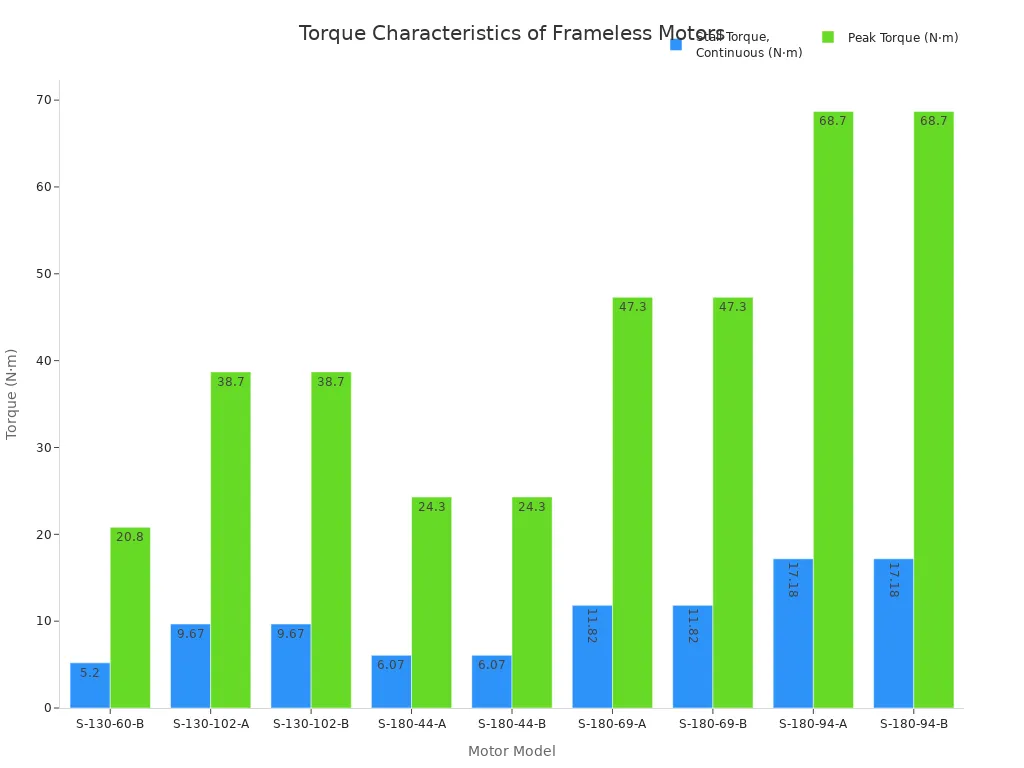
Notice that the S-130-102-A and S-130-102-B share identical torque figures but differ in rated speed. Winding selection, not frame size alone, sets that difference. Use this pattern when you explain how to select the right frameless motor series to a customer weighing speed against torque.
Series Fit for Custom Frameless Motors for Wholesale
60 and 76 Series: Compact, Precision Applications
The 60 and 76 series work for customers who build inside tight spaces. In these designs, size matters more than raw power. A spindle-type application needs a motor that fits into a narrow housing without adding bulk. Robotic joint applications need low inertia and precise motion at the end of an arm. Both series handle these jobs well.
The 60 series gives 0.45 to 1 Nm of rated torque at 3000 rpm. That output works for small rotary tables, precision handling equipment, and compact spindle heads. The 76 series raises the limit to 0.9 to 2.1 Nm at the same speed. Customers who build small rotary tables or light precision handling equipment often choose the 76 series for the extra margin. Neither series has the torque of a larger frame, and neither needs to. Their value comes from fitting where larger frames cannot go.
When you quote custom frameless motors for wholesale in this segment, ask about the mounting interface and the radial space first. A customer with a fixed housing diameter has already set the frame size. Your job is to confirm the stack length and winding that meet the torque target inside that space. Custom-wound frameless motors let you adjust speed and voltage without changing the mechanical fit.
115, 130, and 180 Series: Higher Power Needs
The 115, 130, and 180 series work for larger-envelope OEM machines. These customers need more torque, and they have the space for a bigger frame. The 115 series produces 3 to 6.1 Nm at 2000 to 2500 rpm. Mid-size machine tools and packaging lines fit this profile. The 130 series reaches 5 to 18 Nm across a 400 to 2000 rpm range. Larger envelopes with higher torque demands point here.
The 180 series works for heavy-duty OEM machines. A direct-drive frameless torque motor in this size handles loads that smaller frames cannot. Stack length variants within one frame change the output a lot. The S-180-44-A delivers 6.07 Nm of continuous stall torque, while the S-180-94-B reaches 17.18 Nm. That spread lets you match a single frame size to several machine models.
Torque density rises with frame size, and so does the thermal load. These frameless torque motors depend on the customer's structure to remove heat. Confirm the housing has enough thermal mass and surface area before you recommend a long stack. Each series has a best-fit customer segment. The 60 and 76 series win on fit, and the 115, 130, and 180 series win on power. Neither group ranks above the other. Your customer mix decides which series earns shelf space.
Frameless Motor Pricing and Wholesale Planning
Frameless Motor Wholesale Price Guide Basics
Three business factors shape frameless motor pricing. Customization level comes first. Every change to the magnet, winding, or stack length adds design work, tooling, and testing. Series size matters too. A frameless torque motor costs 20–30% more than a conventional motor because of precision machining, high-grade magnets, and thermal management. Order volume is the strongest lever of all.
Pricing Factor | How It Influences Wholesale Price |
|---|---|
Order volume | Manufacturers spread fixed costs across more units; price breaks appear at 1,000+ units |
Customization level | Custom windings and tighter tolerances add design, tooling, and testing cost |
Series size | Larger frames and higher torque density raise material and process cost |
Use this frameless motor wholesale price guide to build quotes your customers can trust. Ask your supplier for tiered quotes at 100, 500, 1,000, and 5,000 units. That shows where unit price stops dropping. Raw material swings in copper and rare-earth magnets also move wholesale prices, so confirm quote validity periods.
MOQs, Lead Times, and Inventory Mix
Plan your minimum order quantity strategy around customer type. Two common paths exist:
Pay a one-time engineering fee of $2,000–$5,000 and keep a low minimum order quantity, such as 10 units, for specialized projects.
Accept a waived engineering fee with a blanket order or annual volume above 250–500 units for industrial work.
For volume purchases (100+ units), expect 15–30% discounts. However, minimum order quantities (MOQs) may apply.
Standard production runs 15–45 business days. Custom frameless motors typically need 2–6 weeks. Quote these windows honestly and add shipping time. Balance inventory across series by stocking the 60 and 76 sizes for fast turns and holding fewer 115, 130, and 180 units for project work. Combine bulk frameless motor orders to unlock better volume pricing tiers.
Sunrise Electric Motor gives you strong talking points: quality, competitive pricing, fast delivery, and responsive customer service. Position Sunrise as your reliable motor supplier and let those strengths support every wholesale order conversation.
Your role as a selection advisor builds repeat business. Walk each customer through four steps:
Find the application and the space you have to work with.
Confirm the torque, speed, and voltage needs.
Match the closest series.
Check pricing, MOQ, and lead time with your supplier.
This checklist turns how to select the right frameless motor series into a habit you can repeat. It also keeps your custom frameless motors for wholesale quotes accurate. Frameless motors reward careful matching. A well-matched frameless motor means fewer returns. Every frameless motor you recommend should fit the machine. Compare your customer mix to the five series. Gaps show you where the opportunity is. Stock the custom frameless motors your buyers actually ask for.
FAQ
How do I choose between the 60/76 series and the larger frames?
Begin with the space inside the machine. The 60 and 76 series give 0.45 to 2.1 Nm and work well for compact spindle and robotic joint designs. The 115, 130, and 180 series carry more torque for larger OEM machines. Match the frame to the space first, then check speed and voltage.
Can one frame size serve several machine models?
Yes. Stack length and winding variants change the output within a single frame. The S-180-44-A gives 6.07 Nm of continuous stall torque, while the S-180-94-B reaches 17.18 Nm. That range lets you cover several models without adding a new frame size to your line.
What drives lead time on a custom frameless motor order?
Standard production takes 15–45 business days. Custom frameless motors usually need 2–6 weeks. Quote these windows honestly and add shipping time. Check the schedule with your supplier before you promise a delivery date to your customer.
How do I compare suppliers on more than price?
Ask each supplier for tiered quotes at 100, 500, 1,000, and 5,000 units. Request the torque and speed a winding delivers at your customer's bus voltage. Check certifications and export experience. A supplier with strong quality, delivery, and service records protects your margins better than the lowest quote alone.
Does higher torque density always mean a better fit?
No. Torque density goes up with frame size, and so does the heat load. Frameless dc motors run without a housing, so the customer's structure must remove the heat. A long stack in a housing with poor thermal mass limits continuous torque. Confirm cooling capacity before you recommend the larger frame.


Recommended Products

Frameless DC Motor 170 Series

High Efficiency Frameless Inrunner Torque Motor 115 Series

Customized Low Noise Frameless Motor 76 Series for Robotics & Precision Automation

Customized 24V 36V 48V Frameless BLDC Motor 60 Series

Factory Price Frameless DC Motor 180BL for Robotic Arm

220W 3000rpm High Torque Frameless DC Motor 130BL for Robot Joints

Frameless Brushless DC Motor 90BL

36V Frameless BLDC Motor 80BL With Long Life


Recent News
1.How do Frameless DC Motors differ from brushless motors?
2023-03-302.What are some applications for frameless stepper motors?
2023-04-133.Are Frameless torque motor brushless?
2024-11-074.Advantages and Applications of Frameless Brushless DC Motors
2024-12-065.What is a frameless motor?
2025-02-196.What is a Frameless BLDC Motor?
2025-04-157.What are the components of a frameless motor?
2025-07-108.TOP Frameless Motor manufacturer in china
2025-12-269.Frameless Torque Motors Selection and Applications
2026-07-1410.76mm Low Noise Frameless BLDC Motor for Robotics
2026-08-31


